
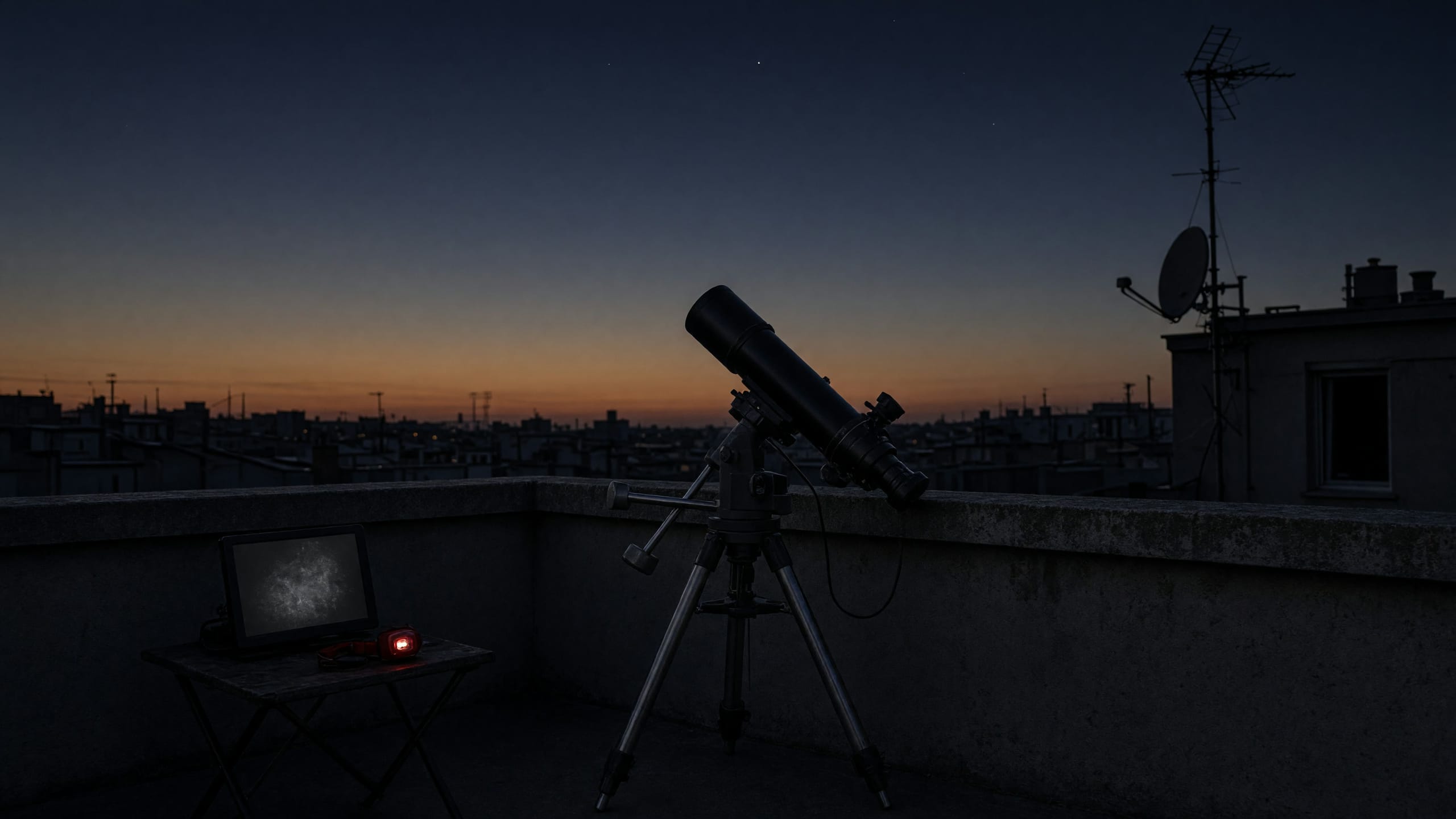
The first hour of a bad sky
This is rung one of nine. It is also the episode people skip, because nothing in it is a photograph of the sky and it reads like preparation rather than astronomy. The first hour of a session is not for taking pictures, and treating it as though it were is the most common way a clear night gets wasted.
You have an hour of usable darkness before you can reasonably start, and what you do with it decides whether the other four hours produce anything. Most people spend it on the thing they are most excited about — pointing at the target — and then spend the rest of the night discovering that something upstream was wrong the whole time.
Three things have to be true before anything else is worth attempting, and they are true in this order.
The mount has to be tracking. Not aligned to your satisfaction — actually tracking, demonstrated on a frame you have looked at. This takes fifteen minutes and it is the only one of the three that cannot be fixed afterwards.
Focus has to be current. Not focused an hour ago. The temperature has moved since then and so has your focuser.
You have to know what the sky is doing tonight. Not what the forecast said. High thin cloud that is invisible to you is entirely visible to a five-minute exposure, and it is the single most common cause of a set that will not stack.
None of that is difficult. All of it is boring, which is why it gets skipped, and the skipping is what produces the four hundred frames you then throw away.
The four kinds of frame
Everything in this course refers back to this table, so it goes here, in the first lesson, before anything else. Three of the four contain no sky at all.
| Frame | What it records | What it removes | When to take it |
|---|---|---|---|
| Light | The sky, and everything wrong with your optics | — | The whole session |
| Dark | The sensor's own noise and its hot pixels | That noise from the lights | Same temperature, same exposure, cap on |
| Flat | Vignetting, dust shadows, uneven illumination | Those, from the lights | Same focus, same orientation, before you move anything |
| Bias | The sensor's read noise floor | That floor from the flats | Any time, shortest possible exposure |
The word people miss is same. A dark frame at a different temperature is not a dark frame; a flat taken after you have rotated the camera is not a flat. Almost every calibration problem in the next eight modules is a violation of that one word.
Two of the four need no sky at all, which is why they are the two people put off and then wish they had not.
The hour, in order
Minutes 0–15 · Set up and balance. Tripod down, legs locked, mount on, tube on, camera on, and only then the counterweight. Balance in both axes with the clutches loose, and balance the declination axis with the camera in the orientation you will actually use — rotating it afterwards undoes what you just did. If the drive has to fight the load, it will do so unevenly, and you will read the result as a tracking fault three weeks from now.
Minutes 15–30 · Polar alignment, to a stated tolerance. Close enough is a number, not a feeling, and the number comes from your focal length and your intended exposure. At 400 mm and two minutes you have a great deal of latitude. At 400 mm and eight minutes you have almost none. Decide the exposure first and align to it; aligning to the best you can manage and then choosing an exposure is how people spend an hour on a job that needed twelve minutes.
Minutes 30–40 · Focus, and a number to prove it. Focus by measurement rather than by eye — whatever your software calls its star-size figure, write the number down. You are not trying to achieve a perfect number. You are establishing tonight's baseline so that when it drifts by twenty per cent at one in the morning you notice, rather than discovering it in the stack.
Minutes 40–50 · One test frame at full exposure, and actually look at it. Not the preview. The frame, at 100%, in the corners. Corner stars tell you about tilt and about tracking; the background level tells you whether your exposure is sensible for tonight's sky; a gradient tells you the moon or a neighbour has arrived. This single frame is the highest-value ten minutes in the session and it is the step most often skipped.
Minutes 50–60 · Darks, while you are still here. Cap on, same exposure, same temperature, walk away. They are worthless later at a different temperature and they cost you nothing now.
Two ways this hour fails
The first is impatience, and it looks like a session that started twenty minutes early. Every frame from it is slightly out of focus in a way that is invisible on a small screen and obvious in a stack of two hundred. There is no recovery; the whole set goes.
The second is misplaced diligence, and it is harder to see. It looks like forty-five minutes of polar alignment for a two-minute exposure, which is an hour spent perfecting the one variable that was already good enough, while focus went unchecked. Precision spent in the wrong place is indistinguishable from carelessness at the far end.
The way to tell them apart is the test frame. Impatience produces a soft frame. Misplaced diligence produces a sharp frame and no time left to shoot it.