
What a flat frame actually fixes
Everybody takes flat frames. Rather fewer people can say in one sentence what a flat frame removes, and that gap is why so many are taken wrongly, and why the result then gets blamed on calibration in general.
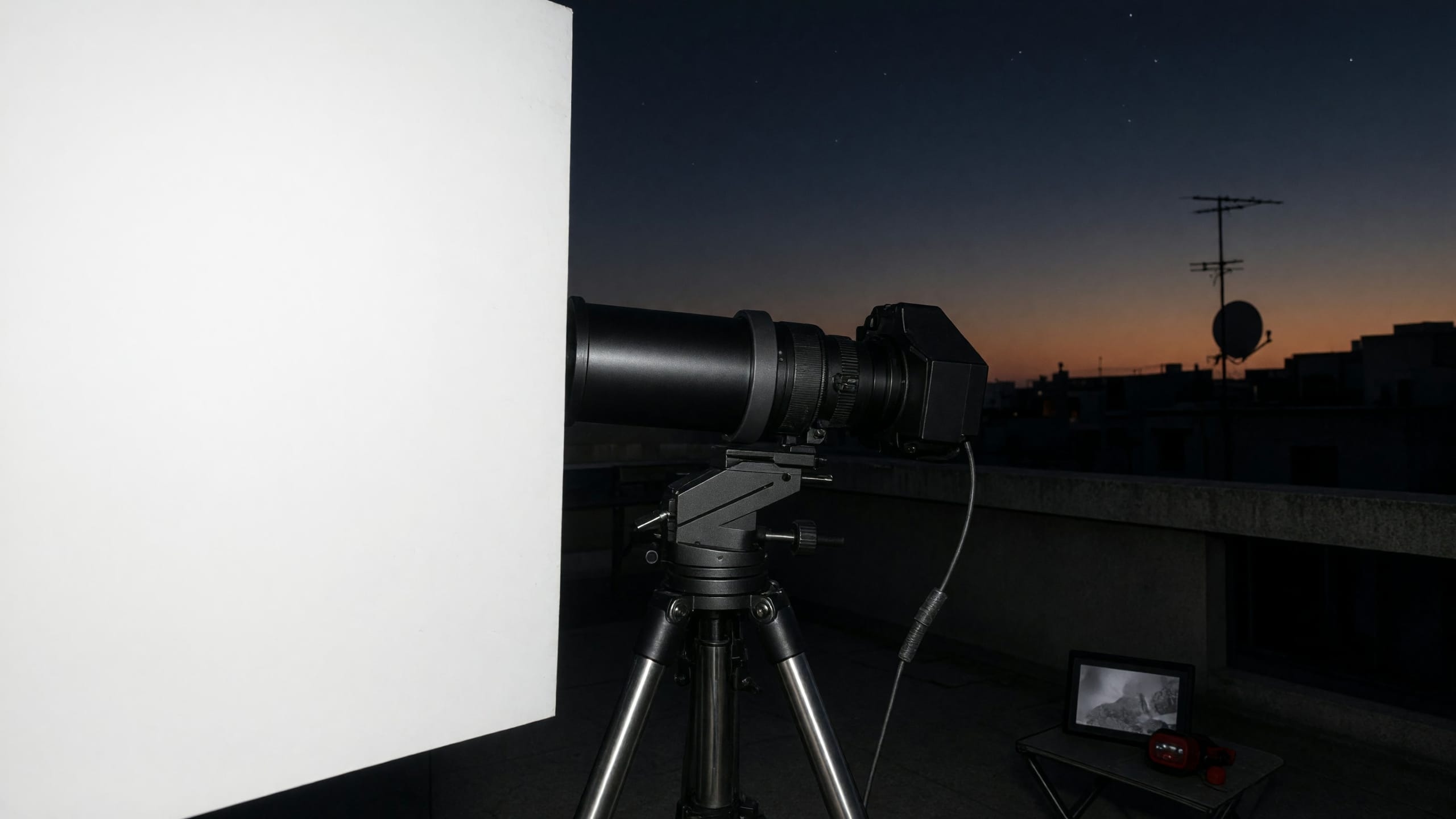
A flat frame is a photograph of an evenly illuminated surface, taken through your optical train exactly as it was when you took the lights. Because the surface is even, anything uneven in that frame was added by the equipment. Divide your light frames by it and the unevenness goes.
That is the whole idea. What follows from it is more interesting than the idea itself.
What it removes
Vignetting. Every optical system delivers less light to the edges of the field than to the centre. It is not a fault and it cannot be adjusted out; it is geometry. A flat measures how much less, and the division corrects it.
Dust shadows. A speck on the sensor window or a filter casts a soft dark disc — the "dust mote" or "dust bunny". A flat records exactly where each one is and how deep.
Uneven illumination generally. An off-axis obstruction, a slightly undersized filter, an internal baffle clipping the cone. Anything that consistently darkens one part of the field.
| Defect | What it looks like | Where it comes from | If you skip the flat |
|---|---|---|---|
| Vignetting | Corners darker than centre, smoothly and symmetrically | Optical geometry; unavoidable | A dark halo the stretch exaggerates, and a gradient correction that then fights it |
| Dust shadows | Soft dark discs, sharpest at small apertures | A speck on the sensor window or a filter | Rings that survive every subsequent step and appear to move between sessions |
| Uneven illumination | One region consistently darker, not symmetric | Obstruction, undersized filter, clipped light cone | An asymmetry you will mistake for skyglow and try to fix with the wrong tool |
What it cannot touch
Here is the list people expect it to fix and it does not: skyglow, moonlight, a neighbour's security light, and any gradient that comes from the sky rather than from the equipment.
The distinction is simple once stated. A flat corrects things that are fixed relative to your optics. A gradient from the sky is fixed relative to the sky, and it moves through the frame as the night goes on and the telescope tracks. Dividing by a flat cannot remove it, and taking better and better flats to try is a way to spend four clear nights achieving nothing — which I did, on nights twenty through twenty-three, and it is the most expensive mistake in the log.
Calibration sits at rung four of nine. That position is the point: it comes after the mount and after focus, because a flat cannot rescue a frame that was not tracking, and it comes before target selection and before anything you do to the stack.
The two ways to take one badly
One: changing something between the lights and the flats. The flat has to describe the same optical train that took the lights. Rotate the camera, and every dust shadow is now in the wrong place — you will not merely fail to remove them, you will add a second set, mirrored. Refocus, and the shadows change size. Remove and refit a filter, and a speck moves. This is why the flats are taken at the end of the session, before anything is touched, and why "I took flats last week" is usually worse than taking none.
Two: exposing it wrongly. A flat that is too dim is mostly read noise, and dividing by noise adds noise to every light frame it touches. A flat that is too bright has clipped highlights, and a clipped pixel carries no information about how much light reached it, so the division is wrong in exactly the places the correction mattered most. Aim for the middle of the histogram — well clear of both ends — and take a good number of them, because they are averaged too.