
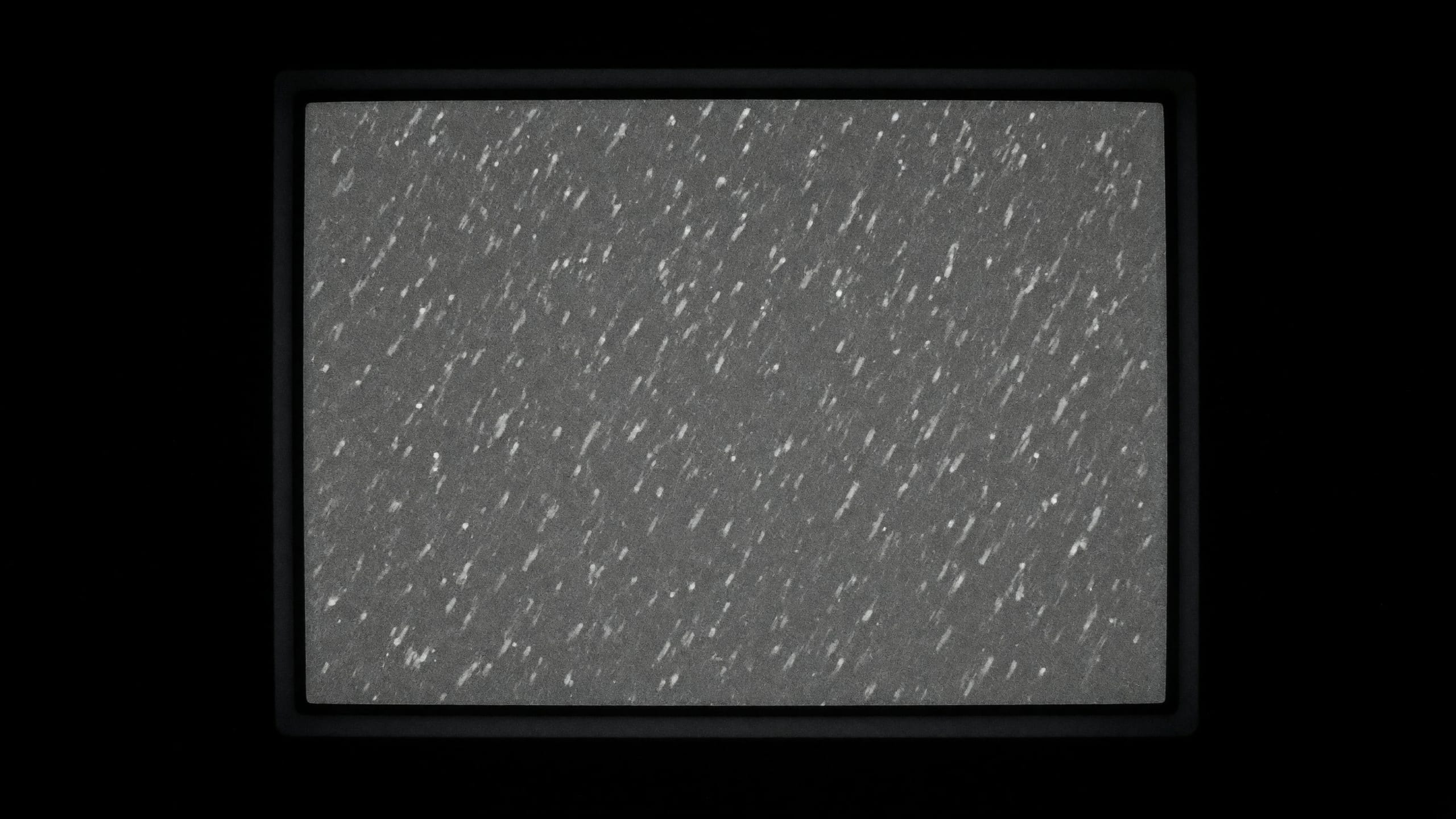
Why your stars are eggs
Four things commonly make a star an egg, and they are not equally likely. More usefully, they do not look the same, and the difference is visible in the frame you already have — which means this is diagnosable before you buy anything or take anything apart.
Before the causes, the symptom, described precisely enough to sort yourself into one of three groups. Open a single sub-frame — not the stack, a single frame — at 100%, and look at four places: the centre, and each of the corners.
Every star in the frame leans the same way, including the centre. The centre is the tell. Optics are radially symmetric, so an optical fault cannot elongate a star at the exact centre of the field. If your centre stars are commas and they point the same way as the corners, this is motion, and it is the mount or something attached to it.
The centre is round and the corners are not. Now it is optical, and the corners will tell you which kind: if all four corners are equally bad and the elongation is radial — pointing outward from the centre like spokes — that is field curvature or a spacing error. If the corners are unequally bad, one edge noticeably worse than the opposite edge, that is tilt.
The centre is round, the corners are unequal, and it got worse through the night. That is flexure, and it is the one people miss, because it is intermittent by nature and looks like whichever of the other three you last suspected.
Those three observations take four minutes and they cut the field from four candidates to one or two. Most people skip them and start with the fix they most want to be true, which is usually "I need a better mount".
The order to check in
The order is not the order of likelihood. It is the order of cost — cheapest test first, so you spend the least to eliminate the most.
One: balance and cable drag. Free, takes five minutes, and accounts for more elongation than the other three combined. Loosen the clutches, balance both axes with the camera in its working orientation, and then watch where the cable goes. A cable that is taut at one point in the mount's travel is a variable load, and a variable load on a drive that is expecting a constant one produces exactly the smeared, one-directional stars people buy new mounts to fix.
Two: exposure length against your alignment. Also free. Take three frames at thirty seconds, ninety seconds and four minutes on the same target. If the thirty-second frames are round and the four-minute frames are not, nothing is broken — you are simply asking for more than the alignment supports. That is a decision, not a fault, and shortening the exposure and taking more frames costs you very little.
Three: sensor tilt. Costs a shim set, if it turns out to be this. Test by rotating the camera ninety degrees and reshooting. If the bad corner rotates with the camera, the tilt is in the camera or its adapter. If the bad corner stays put on the sky, it is in the telescope's focuser or its drawtube.
Four: backfocus spacing. Costs a spacer, and is the one that produces neat radial elongation in all four corners at once. Measure rather than guess; the number is a property of the corrector and it is usually published.
| Cause | What it looks like | Cheapest test | What the fix costs |
|---|---|---|---|
| Balance or cable drag | Every star leans the same way, centre included, worse on one side of the meridian | Rebalance, redress the cable, reshoot | Nothing, and about ten minutes |
| Exposure beyond alignment | Round at 30s, oval at 4 min, evenly across the frame | Three frames at three exposure lengths | Nothing, if you accept shorter frames |
| Sensor tilt | One edge worse than its opposite, centre clean | Rotate the camera 90° and reshoot | A shim set, or a tilt adapter |
| Backfocus spacing | All four corners equally bad, elongation radial | Measure the spacing against the corrector's published figure | A spacer |
| *(and the fifth answer)* | Slight, even, in every corner, at the edge of noticing | — | Nothing, if you can accept it. Many published images have it |