
You do not need a dark site
The most repeated sentence in this hobby is that you should drive somewhere darker. It is true. It is also, for most of the people who are told it, completely unusable — and repeating it to someone with a balcony and a Tuesday evening is not advice, it is a way of ending the conversation.
Here is what a bright sky actually does, because the answer is more specific than "makes it harder" and the specificity is what makes it workable.
Light pollution does not erase the object you are photographing. The photons from the galaxy arrive at your sensor at exactly the same rate whether you are on a mountain or a roof in a city. What changes is what arrives with them: a bright sky adds a large, roughly even flood of unwanted light on top of the thing you want.
That flood is not the problem either — you can subtract a known, even background. The problem is that it is not perfectly even and not perfectly known. It fluctuates, randomly, frame to frame and pixel to pixel. That fluctuation is noise, and noise is the thing you cannot subtract, because there is nothing to subtract: it is different every time you look.
So the object is still there, sitting under a layer of randomness. And there is exactly one way to pull a faint signal out from under randomness, which is to average a great many measurements of it — because the signal adds up consistently and the noise, being random, partially cancels itself.
That is why light pollution costs you time rather than the photograph. More sky glow means more noise means more frames to average before the object emerges. It is not a wall. It is a bill.
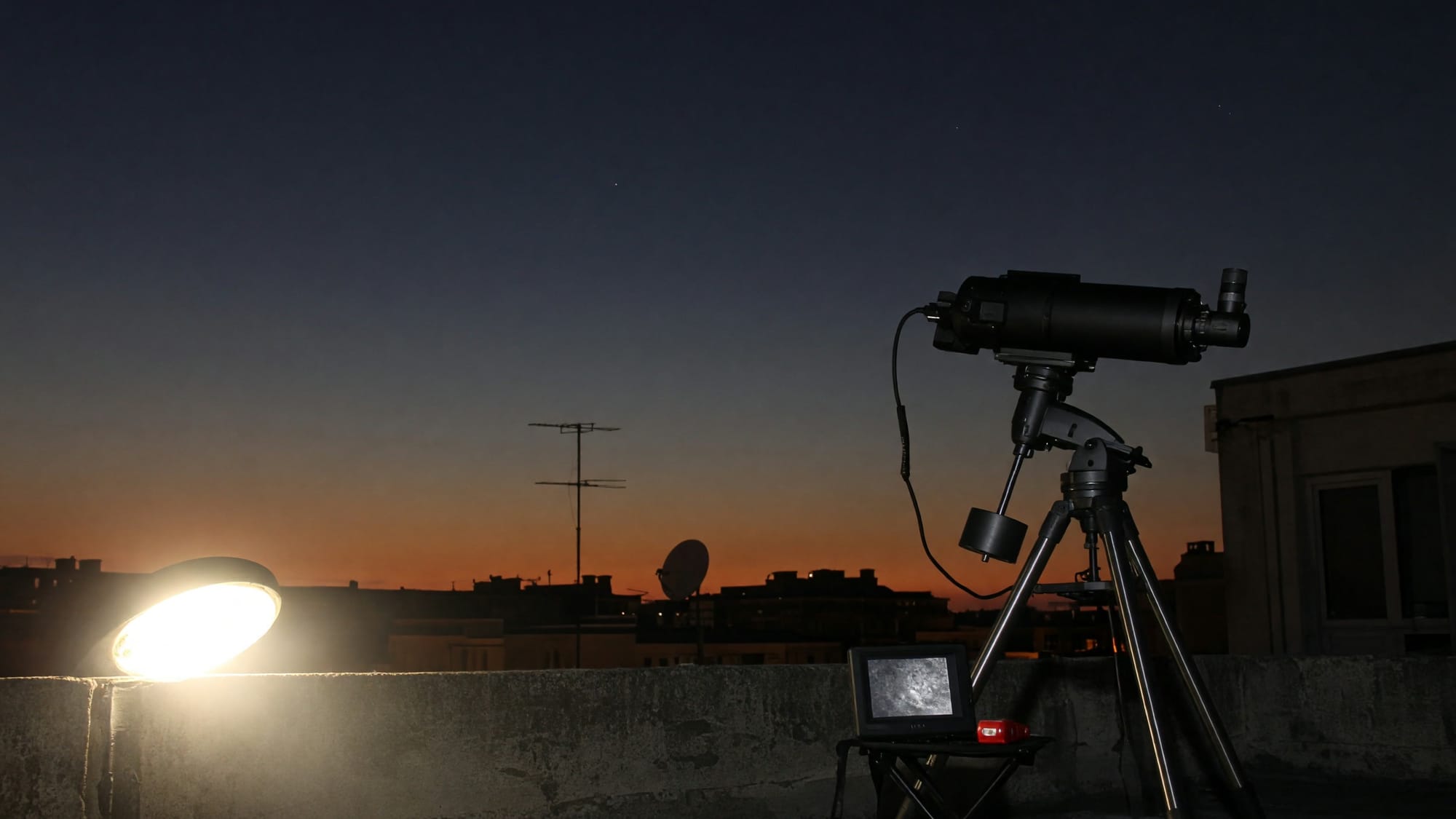
And here is the part the advice leaves out. Time is the one resource a person with a balcony has more of than a person who drives.
A dark site is a trip. It has to be planned around the moon, the weather forecast, the day of the week and whoever else lives in your house. It produces perhaps six to ten usable outings a year for most people, and a bad forecast wastes an entire one. A balcony produces an outing whenever it is clear, including on a Tuesday, including for ninety minutes, including when you cannot be bothered to do anything but let it run while you go back inside.
Ninety minutes on forty Tuesdays is a great deal more integration than four excellent nights in a field.
What a bad sky genuinely takes away
It would be dishonest to stop there, because the trade is not free and pretending otherwise is how people end up disappointed with a technique rather than with a sky.
Faint outer structure goes first. The bright core of a galaxy or a nebula comes through a city sky readily. The dim outer halo — the part that makes an image look like the photographs you admire — is the first casualty, and no amount of processing invents it. Some of it you will simply not get.
Broad colour gets harder. Not impossible, but the subtle large-scale colour transitions are exactly the thing a strong gradient correction tends to flatten, and a bright sky needs a strong gradient correction.
Casualness goes. Under a dark sky you can be sloppy and still get something. Under a bright one, every rung of the ladder has to actually hold, because you have no margin to absorb a second mistake. That is a real cost and it is also, quietly, why people who learn under a bad sky tend to be better at this.
A dark site does not make you better. It makes you faster, which is not the same thing and is much easier to mistake for it.
What to do instead, in three moves
Shorten the exposure and take more of them. A bright sky saturates the background sooner, so long sub-exposures buy you less than they would elsewhere. Shorter frames, many more of them, and the arithmetic works in your favour rather than against it. Module 6 is about how to decide the number.
Correct the gradient properly, once, at the right stage. Not by eye and not repeatedly. A gradient is measurable, and measuring it before you stretch — rather than fighting its consequences afterwards — is the difference between a clean image and a flat one. That is module 8.
Choose targets your sky can actually give you. This is the one that changes results fastest and the one nobody wants to hear. Surface brightness matters more than catalogue magnitude, and a bright compact object under a bad sky beats a large faint one every time. Module 5 exists entirely for this.
None of that requires you to drive anywhere, and all of it is available on a Tuesday.